
MTG Core Set 2021 Booster Box Review
A Core Set 2021 draft booster box is 36 packs. If a listing says 24, the seller has copied a figure that belongs to a different kind of product, and that is the first thing to check before you spend anything.
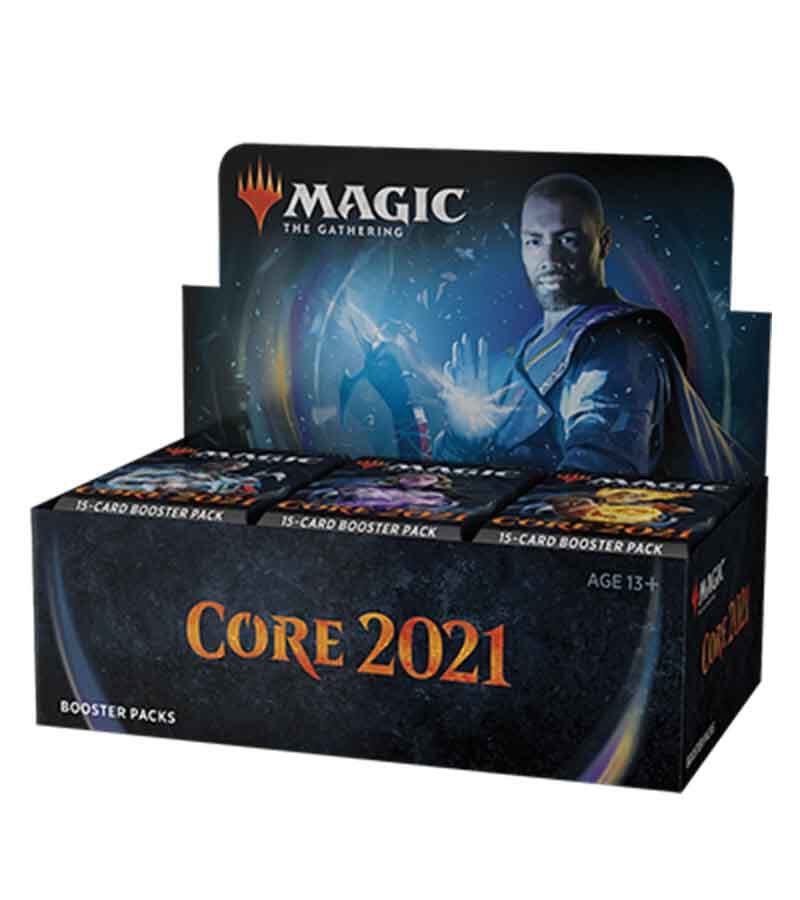
The distinction matters more than it sounds, because the whole case for buying a sealed box rather than singles rests on how many packs you get for the money. Below is what the 36 actually contain, what they can and cannot give you against the printed set, and which M21 cards carry enough value to be worth chasing.
The 36-pack figure, and where the 24 comes from
For most of Magic’s history a booster box, also called a booster display, has held 36 packs. The exceptions are supplemental releases such as the Masters sets, Jumpstart and Conspiracy, which ship 24 to a box. Core Set 2021 is a core set, not a supplemental one, so 36 is the number.
The confusion is easy to trace. Collector booster boxes hold 12. Set booster boxes held 30. Masters-style products hold 24. Anyone writing a listing from memory has four plausible figures to pick from, and a fair number of them pick wrong.
One further point specific to this set: Core Set 2021 was released on 3 July 2020, and set boosters did not exist yet. They arrived with Zendikar Rising that September. A sealed M21 box is therefore a draft booster box or a collector booster box, and nothing else. If a listing offers an M21 set booster box, something about that listing is wrong.
What is inside each of the 36 packs
A draft booster is sixteen cards, of which fifteen are Magic cards and one is a marketing or token card. The fifteen break down as one basic land, ten commons, three uncommons, and one rare or mythic rare.
There is also a chance that one of the commons is replaced by a premium foil of any rarity. When that happens the pack reads as one basic land, one foil, nine commons, three uncommons, and one rare or mythic. That is the whole structure. No bonus slot, no guaranteed showcase card, no second rare.
Wizards does not publish per-slot odds for draft boosters, so anyone quoting a precise mythic rate is estimating rather than citing. That is worth stating plainly rather than inventing a number, because this is exactly the kind of figure that gets repeated until it starts to look official.
What 36 packs gives you against the printed set
Core Set 2021 has 274 cards in the main set: 111 commons, 80 uncommons, 53 rares, 15 mythic rares and 15 basic lands. Counting alternate treatments, borderless planeswalkers, showcase frames, extended art and the promos, the full numbered run reaches 397, but 274 is the figure that matters for a draft box.
Now the arithmetic. Thirty-six packs give 36 rare-or-mythic slots against a combined rare and mythic pool of 68 cards. Even in the impossible case where you never open a duplicate, one box gets you a little past half the rare sheet. In practice duplicates start early and you finish well short.
The commons and uncommons go the other way. Thirty-six packs is 360 common slots against 111 commons, and 108 uncommon slots against 80 uncommons. You will not quite complete either sheet, because each pack is filled at random rather than dealt out card by card, but you will get close enough that the gaps are cheap to fill.
That is the honest shape of a box: near-complete at the bottom, roughly half-done at the top, and no realistic path to a full set without a second box or a singles order.
What a draft box does not contain
The gap between 274 and 397 is where the collecting side of M21 lives, and almost none of it is in a draft booster box.
The borderless planeswalkers are numbered 279 to 284. The showcase-frame cards run from 285 to 313, and the extended-art versions from 340 to 391. The Buy-a-Box promo is 278 and the bundle promo is 392. Those alternate treatments are collector booster and promotional territory, so a draft box will not produce them except by way of the ordinary foil slot, and even then only in the standard frame.
Teferi is the clearest example of the split. He is the featured planeswalker, and Teferi, Master of Time exists as card 75 plus three further artworks numbered 275 to 277 in the main run, before you count the borderless and extended versions. Four subtly different pieces of art for one card is a collector’s problem, not a drafter’s, and the box you buy determines which of those two problems you have bought.
If the alternate frames are what you are after, a draft box is the wrong product and no amount of opening will fix that. A collector booster box, which holds 12 packs rather than 36, is the one built for it.
The cards that carry the value
Fifteen mythics appear in boosters. Five more exist only inside the planeswalker decks, so they are not in the box at all: Basri, Devoted Paladin, Teferi, Timeless Voyager, Liliana, Death Mage, Chandra, Flame’s Catalyst and Garruk, Savage Herald. A sixth, Rin and Seri, Inseparable, is the Buy-a-Box promo at number 278 and never came out of a pack either, which is worth knowing because it sells for about 3.60 and looks like an ordinary M21 mythic in a listing.
Of the fifteen you can actually open, the ones worth real money at the time of writing are Terror of the Peaks at around 27 euros, Chromatic Orrery near 18, Grim Tutor at roughly 17, and Ugin, the Spirit Dragon at about 12. Fiery Emancipation sits near 9 and Teferi, Master of Time near 7.
Then the drop is steep. Elder Gargaroth and Massacre Wurm are around 3.50. Baneslayer Angel and Liliana, Waker of the Dead are near 2. Mangara, the Diplomat, Basri Ket and Discontinuity are close to 1. Garruk, Unleashed is under a euro, and Chandra, Heart of Fire is roughly 20 cents.
The rares tell the same story. Heroic Intervention tops the sheet at about 13 euros, then Vito, Thorn of the Dusk Rose and Azusa, Lost but Seeking sit near 8, Conspicuous Snoop near 4, and Fabled Passage, Teferi’s Ageless Insight, Chandra’s Incinerator and Sanctum of All cluster between 2 and 2.60.
So: 36 rare-or-mythic slots drawn from a pool of 68 cards in which four are worth double figures and most of the rest are worth less than a coffee. That is not an argument against the box. It is an argument against buying one expecting the singles to cover the cost, which they will not on any typical opening.
Where the box does make sense
Draft. Eight players at three packs each is 24 packs, so one box runs a full eight-person draft and leaves twelve over for a smaller second event or for opening at home. That is the cleanest justification for buying sealed rather than singles, and the arithmetic actually supports it.
Core Set 2021 is decent draft material for the reason core sets usually are. The design leans on clear, self-contained cards rather than a heavy mechanical theme, which makes it forgiving for players who have not drafted much. Teferi is the featured planeswalker and the set is built around his circle, with Basri Ket as the one genuinely new face. Draft booster wrappers carry key art of Teferi, Liliana and Chandra; the collector booster carries Ugin.
The practical consequence at the table is that colour pairs stay legible. There is enough removal and enough playable common creature curve in every colour that a pool which refuses to cooperate can usually be salvaged by pivoting rather than by starting over, which is the single most useful property a set can have for a room with mixed experience levels.
Buying a sealed box now
Two things to check, and neither is the price.
The first is whether the box is genuinely sealed. M21 is old enough that resealed boxes are a real risk, and the tell is usually the shrink wrap. Factory wrap is tight, with clean folds at the corners and no loose seams. A box that has been opened, searched and rewrapped tends to have slightly soft corners and a seam running somewhere unusual. If the listing photograph does not show the corners and the seam, ask for one.
The second is what you are actually being sold. Draft booster box, collector booster box, bundle, planeswalker deck and starter kit are five different products at five different prices, and listing titles compress them badly. The pack count is the fastest way to tell them apart: 36 means draft, 12 means collector, and anything else means it is not a booster box.
If what you want is one specific card rather than the experience, buy the card. Terror of the Peaks at 27 euros is cheaper than a box, arrives in the condition you agreed to, and does not depend on 36 coin flips going your way.
Verdict
Six out of ten, and the score is about the value proposition rather than the set.
Core Set 2021 is a competent, readable core set, and a box of it runs a full draft night with packs to spare, which is a genuinely good use of the money. What holds the score down is what the sealed-box format implicitly promises and does not deliver here: the top of the rarity sheet is thin, four cards carry most of the value, and the odds of a box paying for itself in singles are poor enough that nobody should buy one on that basis.
Buy it to open with people. Do not buy it as inventory.
For the single-pack version of this question, including what one booster feels like to open rather than 36, see the Core Set 2021 draft booster pack review.




Deja un comentario