
MTG Core Set 2021 Draft Booster Pack Review
A Core Set 2021 draft booster is sixteen cards, and fourteen of them are worth about 1.40 euros put together. That is not a criticism of the set. It is the arithmetic of every draft booster ever printed, and it is the thing worth understanding before you buy one pack, three packs or thirty-six.
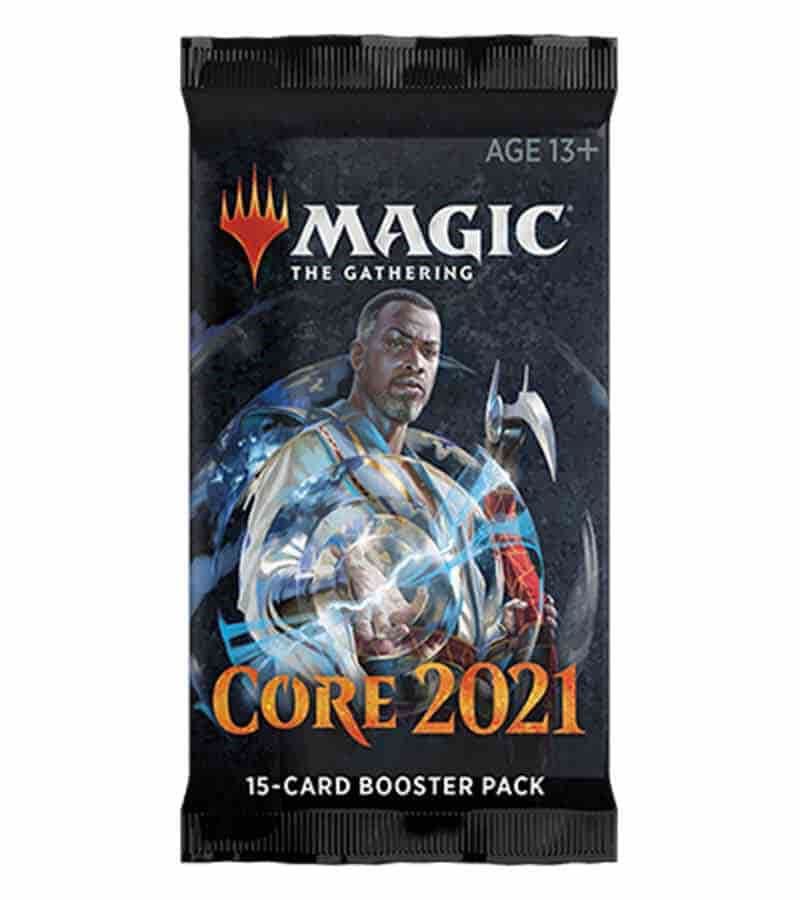
What follows is what one pack contains, what each slot in it is actually worth at current single prices, and what the set is like to draft once you have three of them in front of you.
What is actually in the pack
Sixteen cards, of which fifteen are Magic cards and one is a marketing or token card. The fifteen break down as one basic land, ten commons, three uncommons, and one rare or mythic rare.
Three uncommons, not three or four. That range gets repeated a lot, and it comes from confusing the uncommon count with the foil slot: any one of the ten commons can be replaced by a premium foil of any rarity, so a pack with a foil uncommon in it looks like a four-uncommon pack. It is still three uncommons plus a foil that happened to land on that rarity. When the foil appears, the pack reads as one basic land, one foil, nine commons, three uncommons, and one rare or mythic.
That is the entire structure. No bonus slot, no guaranteed showcase card, no second rare. Core Set 2021 was released on 3 July 2020, before set boosters existed, so the draft booster is the plain one by design rather than by omission.
Wizards does not publish per-slot odds for draft boosters. Anyone quoting you a precise mythic rate is estimating, and the estimate has usually been copied several times before it reached you.
What the other fourteen cards are worth
This is where a pack review normally goes vague. It does not have to.
Core Set 2021 has 111 commons in its main numbering. Not one of them reaches a euro as a single. The most expensive is Village Rites at about 33 cents, then Alpine Watchdog at 21, Llanowar Visionary at 19, Daybreak Charger at 18 and Frantic Inventory at 17. The median common is 7 cents.
The 80 uncommons do better, but only just. Exactly two clear a euro: Sanctum of Stone Fangs at about 1.51 and Miscast at 1.26. Behind them Tormod’s Crypt sits at 60 cents, Rewind at 57, Palladium Myr and Unleash Fury at 52, Indulging Patrician at 51, Conclave Mentor at 49, Garruk’s Uprising at 47 and Cultivate at 43. The median uncommon is 13 cents.
So: ten commons at an average of 8 cents, three uncommons at an average of 21 cents, and one basic land worth nothing. Call it 1.40 euros for fourteen of the fifteen Magic cards in a typical pack, and that figure is generous, because it assumes you never open a duplicate you already have.
The rare slot carries everything
One card in the pack has to justify the price, and the spread behind it is wide.
The rare slot draws from a pool of 68: 53 rares and 15 mythics. On the rare side, only twelve of the 53 clear a euro. Heroic Intervention leads at about 12.69, then Vito, Thorn of the Dusk Rose at 8.34 and Azusa, Lost but Seeking at 8.22, with Conspicuous Snoop at 4.08 and a cluster around 2 to 2.60. The median rare is 37 cents, which is worth sitting with for a moment: more than half the time, the rare in your pack is worth less than a common from a good set.
Mythics invert that. Thirteen of the fifteen clear a euro, and the top of the sheet is where M21 keeps its money: Terror of the Peaks at roughly 27, Chromatic Orrery at 18, Grim Tutor at 17.50, Ugin, the Spirit Dragon at 12 and Fiery Emancipation at 9.40. The median mythic is 3.45.
The gap between the two is the whole story of the slot. The average rare is worth about 1.17 and the average mythic about 7.16, so the same card slot is worth roughly six times more on the occasions it comes up mythic, and Wizards has not told anyone how often that is. Put the three rarities you can open in quantity together and the shape is stark: of the 244 commons, uncommons and rares in the main set, 230 are worth less than a euro. Fourteen cards out of 244 carry the sheet, and the mythics sit on top of those.
The honest summary is that a pack has one slot with any real variance in it, that slot is a coin flip weighted heavily towards disappointment, and the pleasant outcomes are concentrated in a handful of mythics you are unlikely to see. Buying single packs hoping to hit Terror of the Peaks is a worse plan than buying Terror of the Peaks.
What a single pack cannot contain
Some Core Set 2021 cards never came out of a draft booster at all, and they turn up in listings looking like ordinary set cards.
Five uncommons exist only inside the planeswalker decks: Historian of Zhalfir, Keral Keep Disciples, Liliana’s Scrounger, Predatory Wurm and Sigiled Contender. Five mythics are in the same position, as is Rin and Seri, Inseparable, which was the Buy-a-Box promo. The borderless planeswalkers, the showcase frames and the extended-art versions are collector booster and promotional territory.
Practically, this matters in two directions. If you are trying to complete the set from packs, there is a floor you cannot reach by opening more of them. And if you are buying singles to fill gaps, a card being cheap does not mean it was common in packs, because some of these never were in packs at all.
The uncommons are the ones that catch people out. A mythic that only came in a planeswalker deck is well documented and easy to look up, but Predatory Wurm or Sigiled Contender look like ordinary filler in a listing, and a seller describing a lot as “from booster packs” may believe it. If the exact provenance of a lot matters to you, those five names are the ones to check first.
One pack, or three, or a box
A draft is three packs per player. That is the number that should drive the decision.
Buying one pack is an impulse purchase and should be treated as one: you are paying for two minutes of opening a thing, and on the balance of probability you will end up with about two euros of cardboard. There is nothing wrong with that as long as it is what you think you are buying.
Three packs is a different proposition, because that is a sealed pool you can actually build with, and it is the unit the product was designed around. Eight players at three packs each is 24 packs, which is why a 36-pack box works out cheaper per pack than buying two dozen singles off a shelf, and leaves twelve over. If you are organising a draft night rather than scratching an itch, the box is the purchase and the Core Set 2021 booster box review goes through that arithmetic properly.
How the set actually drafts
Core Set 2021 is good beginner draft material, and for a specific reason rather than a vague one: it is a core set, so the cards are largely self-contained. There is no set-wide mechanic you have to learn before your picks make sense, and no archetype that collapses if you miss one uncommon.
The practical consequence at the table is that colour pairs stay legible. Every colour has enough removal and enough playable common creatures that a pool refusing to cooperate can usually be salvaged by pivoting rather than starting over, which is the single most useful property a set can have for a room with mixed experience. A first-time drafter who commits to two colours and a sensible curve will end up with a functional deck, which is not true of every set.
Teferi is the set’s featured planeswalker and Basri Ket is the one genuinely new face. The draft booster wrappers carry key art of Teferi, Liliana and Chandra.
The limitation is the flip side of the same design. A set built to be readable is also a set with a lower ceiling, and experienced drafters tend to find M21 a competent evening rather than a memorable one. The decisions are real but they are rarely surprising.
Verdict
Seven out of ten, and the number is about the pack rather than the set.
As draft material Core Set 2021 does its job well, and as a first drafting environment it is genuinely one of the better options. What holds the score down is the format this review is nominally about. A single draft booster is the worst way to buy into M21: fourteen of its fifteen cards are worth about 1.40 euros together, the fifteenth is a slot where the median outcome is 37 cents, and the cards that would make it exciting are concentrated in fifteen mythics you will mostly not see.
Buy three if you want a sealed pool. Buy a box if you want a draft night. Buy one if you want to open one, which is a perfectly good reason as long as it is the reason.




Deja un comentario