
MTG Sixth Edition Booster Pack Review
A Sixth Edition booster is fifteen cards, and the three most interesting ones are usually not the rare. That is unusual enough to be the reason to write about this pack rather than any other 1999 product.
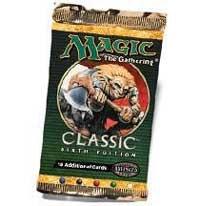
What follows is the set behind the pack, what each rarity is actually worth today, the one category of card this product cannot contain, and why the release mattered more for its rulebook than for its cards.
What is actually in the pack
Fifteen cards: 11 commons, 3 uncommons and 1 rare. No foil slot, no bonus card, nothing else beyond that.
The set they come from is unusually tidy. Classic Sixth Edition, released in April 1999, is 350 cards arranged as 110 commons, 110 uncommons, 110 rares and 20 basic land printings. Three equal sheets and a set of lands. Core sets of the period were rarely so symmetrical, and it makes the arithmetic of a pack easier to follow than it is for most products.
The number is also a deliberate cut. Fifth Edition, which this set replaced, ran to 449 cards and remains the largest Magic set ever printed. Sixth Edition dropped a hundred of them. That is the difference between a core set assembled to include everything still legal and one edited down to what a new player could reasonably be handed, and it is why a pack of this set repeats cards more often than a pack of the one before it.
It was also the first core set to carry an expansion symbol, the Roman numeral VI, which it needed precisely because it now had to indicate rarity. Collector numbers and centred artist credits arrived at the same time, and the basic lands dropped their rules text in favour of a single large mana symbol.
The commons are worth almost nothing
This is the part a pack review usually skips, and it does not have to be skipped.
Of the 110 commons, exactly two reach a euro as singles: Counterspell at about 1.40 and Vitalize at about 1.05. The median common is 9 cents and the mean is 13. Behind the top two, Blood Pet sits at 54 cents, Memory Lapse at 50, Fog at 38 and Pacifism at 33, and the curve flattens fast after that.
There is a small oddity worth noting. The 20 basic land printings have a median of 28 cents, which is higher than the median common and higher than the mean common. Old basic land art has a collector market of its own, so the least important card in a 1999 pack is frequently worth more than the ordinary commons sitting next to it.
Eleven commons at an average of 13 cents is about 1.46 euros. That is the floor of the pack.
The uncommons hold the surprise
Here the set stops behaving like a core set.
The median uncommon is 21 cents, so most of the sheet is as unremarkable as the commons. But four uncommons clear ten euros, and three of them are the same cycle: Enlightened Tutor at roughly 25, Worldly Tutor at 17 and Mystical Tutor at 12, with Ashnod’s Altar at about 10.50 alongside them.
That matters because of what it does to the pack. Enlightened Tutor is worth more than every rare in Sixth Edition except two. A pack that opens a mediocre rare and an Enlightened Tutor has put its value in the wrong slot entirely, and the tutor is the card most likely to be overlooked by someone sorting a bulk lot by rarity symbol rather than by name.
Fourteen of the 110 uncommons reach a euro. Below the tutors the drop is immediate: Crystal Vein at 5.13, Goblin Recruiter at 4.17, Warmth at 3.74, Chill at 3.52, and then everything else under 1.35.
Three uncommons at an average of one euro is about 3.01, but that average is almost entirely three cards. The median outcome for the uncommon slots is closer to 63 cents for all three together.
What the rare slot is worth
One card per pack is supposed to justify the purchase, and here the spread is wide but the middle is low.
Vampiric Tutor leads the set at about 45 euros, well clear of everything else. Behind it City of Brass sits near 17, Birds of Paradise near 14, and Armageddon and Final Fortune both around 10. Those five are the only rares in the set that reach double figures.
After them the pain lands quickly. Adarkar Wastes is at 7.87, Ankh of Mishra at 7.67, Karplusan Forest at 7.50, Meekstone at 7.45 and Underground River at 7.21, and then the painland cycle and a handful of artifacts carry the five-euro band. Forty of the 110 rares reach a euro, which means seventy do not. The median rare is 68 cents.
The painlands are the most predictable part of that band, and the only complete cycle in the set worth chasing. All five are rares in this pack pool: Adarkar Wastes at 7.87, Karplusan Forest at 7.50, Underground River at 7.21, Sulfurous Springs at 5.18 and Brushland at 4.59. Nothing in the cycle is a jackpot, but nothing in it is worthless either, which is unusual for a rare sheet where seventy cards sit under a euro. If a sealed pack is being opened for anything other than the wrapper, this cycle is the realistic good outcome rather than Vampiric Tutor.
Put the whole set together and the shape is stark: of the 330 non-basic cards in Sixth Edition, 272 are worth less than a euro. Nine cards carry the set.
The consequence for a sealed pack is a large gap between the average and the typical. Using mean prices, a pack works out at roughly 6.85 euros of singles. Using medians, the same pack is about 2.30. The first figure is what the set is worth divided by the packs it came in; the second is closer to what any given wrapper will actually hold. Nine cards out of 330 are the entire difference between them.
The one thing this pack cannot contain
Sixth Edition has no foils. Not rare foils, not hard-to-pull foils. None were printed.
This is worth stating plainly because the timing invites the mistake. Premium foil cards had entered Magic in Urza’s Legacy in February 1999, two months before Sixth Edition shipped, so foils demonstrably existed while this product was on shelves. They were an expansion feature at that point. Seventh Edition in April 2001 was the first core set to include them.
So a listing that offers a foil Sixth Edition card, or a pack described as varying in its shine from one print run to the next, is describing something that was never printed. The only gloss on these cards is the ordinary finish of the period’s card stock.
The rules were the actual product
The cards in Sixth Edition are mostly reprints. The rulebook was not, and it is the reason the set is remembered.
Sixth Edition carried the largest rules revision in Magic’s history to that point. Batch resolution was replaced by the stack, so spells could be added freely and resolved one at a time, last in first out. Interrupts were eliminated as redundant and folded into instants. Mana source spells such as Dark Ritual became instants and therefore counterable, while mana abilities kept bypassing the stack. The damage-prevention step was dropped, so damage now applies on resolution and prevention has to be played in advance. Combat was broken into defined steps with a window in each. Banding was retired.
The wording changed with it. Summon spells became creature spells, tapped artifacts were defined as still working unless they said otherwise, and a player at zero life began losing as soon as anyone received priority rather than surviving to the end of the phase.
It was divisive at the time, and the complaint that the previous state of the game was the real one outlived the argument. What is not in dispute is that the game played after April 1999 is recognisably the game played now, and the game played before it is not.
Where it sits in the calendar
One common error is worth correcting because it changes how the set reads. Sixth Edition did not follow the Urza block. It landed in the middle of it.
Urza’s Saga arrived in October 1998 and Urza’s Legacy in February 1999. Sixth Edition came in April 1999, and Urza’s Destiny followed in June. Mercadian Masques opened the next block that October, and Invasion was still eighteen months away. A pack of this set is a snapshot of the game at its most broken competitively, released between two of the most powerful expansions ever printed, which is part of why the rules overhaul was needed at all.
Verdict
Six out of ten, and the score is about the sealed pack rather than the set.
As a set, Sixth Edition is genuinely significant, and the tutor cycle at uncommon gives it a quirk that most core sets lack. As fifteen cards in a wrapper, it is a poor proposition: 272 of the 330 cards in it are worth under a euro, the median pack holds about 2.30 euros of singles, and the nine cards that would make it exciting are spread across a 330-card pool.
Buy a sealed pack because a 1999 wrapper is a pleasant object and the rules-change story is attached to it. Do not buy one expecting the contents to matter. If a specific card is what you want, Vampiric Tutor and Enlightened Tutor are both cheaper to buy outright than to chase. For the same arithmetic applied to a modern product, the Core Set 2021 draft booster review covers a pack built to very different rules.




Deja un comentario