
Dragon Ball Super Cross Worlds (2018) Review
Series 3 of the Dragon Ball Super Card Game is the set where Bandai added a fifth colour. Almost everything worth saying about Cross Worlds follows from that one decision, and most of what was written about the set at the time buried it under theme talk.
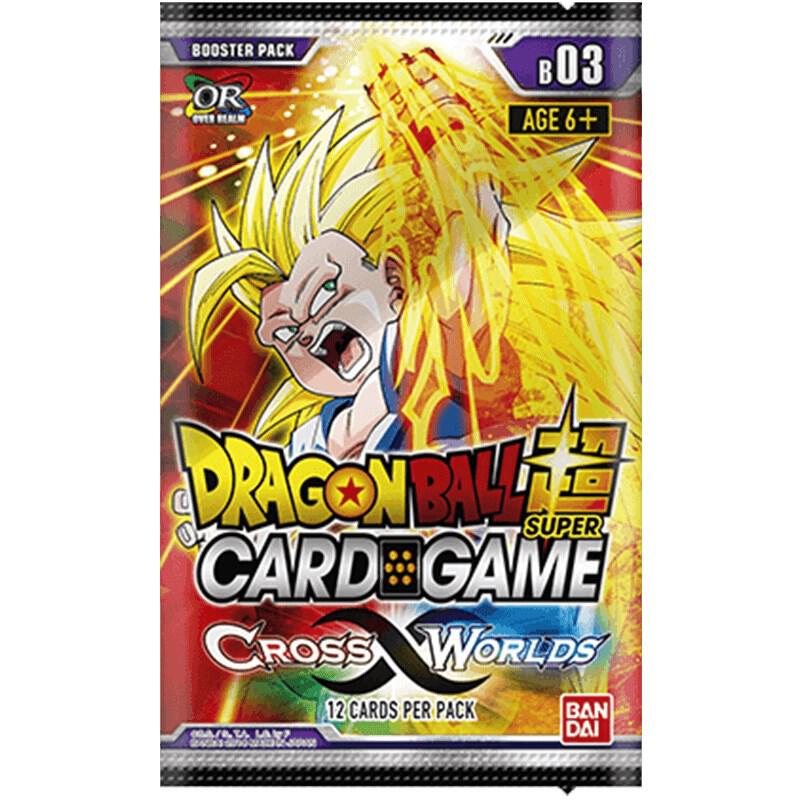
What DBS-B03 actually is
Cross Worlds released on 9 March 2018 as the third booster set of the game, product code DBS-B03. Packs held 12 cards and carried a 3.99 dollar MSRP, with 24 packs to a sealed box.
The set runs to 127 distinct cards: 60 commons, 30 uncommons, 18 rares, 14 super rares, 4 special rares and a single secret rare. Bandai’s own marketing figure for the set is 217, which counts foil versions as separate types. Both numbers are correct, they are just counting different things, and it is worth knowing which one a seller is quoting before you decide a lot is complete.
The four special rares are the ones that matter to collectors. Bandai’s own description is that special rares are mechanically identical to super rares but carry different artwork, which is exactly the kind of card that holds value on looks alone once nobody is playing the format any more.
Black is the headline
Before Cross Worlds the game ran on four colours. This set added Black, presented as the emissary of darkness and tied to Dragon Ball Xenoverse 2 rather than to the anime.
Adding a colour to a card game that is barely a year old is a bigger move than adding a hundred cards to an existing one. Every deckbuilding assumption in the game had been formed around four options, and a fifth changes the arithmetic of every multicolour build at once. It also gives Bandai somewhere to put mechanics that would have warped an existing colour’s identity, which is what happened here: Black arrived with its own way of removing cards from the game, sending them to a separate out-of-play zone rather than to the drop area where the rest of the game’s discard effects can reach them.
That is a genuinely different kind of answer to a threat, and in 2018 it was the most interesting thing in the set. A card that goes to a normal discard pile is a card someone might get back. A card that leaves the game entirely is a decision. Whether you like Black or not depends largely on whether you think a card game benefits from having an answer that cannot be undone.
The other consequence is quieter and took longer to show up. In this game the Leader fixes your colour, so a fifth option does not give existing decks a new tool, it gives Bandai a fifth axis to design along. Every set after this one had to be balanced across five colours instead of four, which means slower coverage: a colour that misses out on a mechanic in one set waits longer for its turn to come around. That is the tax a young game pays for expanding its palette, and it is the part nobody puts on the box.
The crossing-eras hook is more than flavour
The set’s pitch is that the dimensional gates have opened and every era of Dragon Ball arrives at once. Set concepts like this are usually marketing, but here it doubles as an explanation of the card pool, and the mapping is specific rather than vague.
Bandai’s own breakdown puts the original Dragon Ball into Yellow, built around Goku’s origins. Dragon Ball Z gets two entries: Green, with Android 13, and Blue, with Kid Buu. Dragon Ball GT arrives in Red on a Machine Mutant theme, and Dragon Ball Super sits in Green around the Tournament of Power.
The useful part of that list is Dragon Ball GT. Bringing GT into the game gave Bandai a character pool that had barely been touched anywhere else, which is why this set feels distinct from the two before it in a way that a straight power bump would not have. The Universe Survival additions are the opposite case: those characters were current in 2018 and the set was riding the anime.
What you are actually buying in 2026
There are two honest reasons to buy Cross Worlds today, and they are not the same reason.
If you are collecting, the four special rares and the single secret rare are the targets, and sealed product is worth what someone will pay for an intact 2018 box. The alternate art on the special rares is the durable part of the value, because artwork survives format rotation and playability does not.
If you want to play with it, do the boring thing first and confirm what your local scene runs. The game has moved through the Zenkai Series and into the Ultra Bout Series since 2018, with new card types and a new Leader colour along the way. A 2018 booster set is not automatically legal in whatever a shop is running this month, and finding that out after buying a box is an avoidable annoyance.
Series 3 also came with more than the boosters. Bandai released two starter decks alongside it, The Dark Invasion and The Extreme Evolution, plus a Cross Worlds special pack set. If what you want is a playable object rather than a chase, a starter deck is the cheaper and more sensible entry point, and it was designed to be one.
There was also a store promotion attached to the launch: buying Series 3 boosters, or both Series 3 starter decks, earned a free promo card at participating shops. Eight years on, that is the detail worth remembering when a listing describes a lot as complete. Launch promos were never in the boosters, they are not counted in either the 127 or the 217, and they are the hardest part of a Series 3 collection to source now precisely because they were handed out over a counter rather than printed into a product.
The rarity split, and what a box gets you
The arithmetic is worth doing before you buy sealed. A 24 pack box at 12 cards a pack is 288 cards. The set is 127 distinct cards, of which 60 are commons, so nearly half the pool sits in the slot you will see most often.
The top end is where it gets awkward. Fourteen super rares is a lot for a set this size, and above them sit four special rares and one secret rare. Bandai did not publish per-slot pull rates that I have been able to verify, so I am not going to quote one, but the shape of the distribution tells you enough on its own: a single box is a reasonable way to get most of the commons and uncommons and a poor way to target any specific card at the top.
That is the practical case for singles. If you want the secret rare, buy the secret rare. Opening sealed to find it is a considerably more expensive way to end up with the same card plus 287 others.
How it sits next to Series 1
Compared with Galactic Battle, the game’s opening set, Cross Worlds is doing a different job. Series 1 had to establish what the game was. Series 3 had the luxury of an established game to complicate, and it spent that luxury on a structural change rather than on raising numbers.
That is the right call and it is also the reason the set aged reasonably well as a collectible. Sets that exist to push power level look embarrassing three years later. Sets that introduce a colour stay historically interesting, because the colour is still there.
What the set does not do
It does not fix the game’s speed. Cross Worlds added tools rather than brakes, and the complaint from 2018 that games could be decided before the interesting cards came down was not something a booster set was ever going to solve.
It is also a set that rewards buying singles over sealed if you have a specific target. 127 distinct cards spread across a 24 pack box means a box will not complete the set, and the pull rates on the special rares are the whole reason to open sealed in the first place. Buy sealed for the gamble and the unboxing, buy singles if you want particular cards. Deciding which of those you are doing before you spend is most of the skill in buying an old TCG set.
Verdict
Eight out of ten as a set, judged on what it was trying to do in 2018.
Adding a fifth colour to a young game is a real design decision, Black arrived with a mechanic that behaves differently from anything already in the game, and pulling Dragon Ball GT into the card pool gave the set an identity that the numbers alone would not have given it. The 217 figure is inflated by foils, the box will not complete the set, and anyone buying it to play needs to check format legality first. None of that is a reason to avoid it, but all of it is a reason to know what you are buying.
Card-by-card specifics, including current rulings, live on Bandai’s official card list at dbs-cardgame.com, which is the only source worth trusting for what a card does today.




Deja un comentario